


By Veronica Panama | July 28, 2026
Rain or shine, ISCBC’s invasive mussel monitoring crew is visiting 12 lakes across the Cariboo region this year!
Invasive mussels may be small, but they cause big impacts. They clog water infrastructure, damage boats and docks, outcompete native species, and can permanently change lake ecosystems. Once established, they are almost impossible to remove, making prevention essential. Fortunately, there are no confirmed reports of invasive mussels in B.C. and the plan is to keep it that way.


Damaged watercraft propreller heavily encrusted with invasive mussels. Photo Credit: Robert Walters Colorado Parks and Wildlife
The invasive mussels of concern in B.C. include zebra mussel (Dreissena polymorpha), quagga mussel (Dreissena rostriformis bugensis), and golden mussel (Limnoperna fortunei). These small shellfish are highly adaptable and can spread quickly. Zebra and quagga mussels are freshwater species, while golden mussels are also a freshwater mussel they can survive in brackish water— a mixture of freshwater and saltwater.
In recent years, invasive mussel detections have prompted rapid-response efforts in nearby jurisdictions, including Idaho’s Snake River and Lake of the Prairies in Manitoba. In 2024, golden mussels were detected in California, marking the first confirmed detection of the species in North America. They have since been confirmed at multiple locations in California, underscoring the importance of continued monitoring. Early detection allows for rapid response to contain and assess control options if invasive mussels are detected in a waterway.
Meet the Mussels
Zebra and quagga mussels are very small (around the size of a fingernail), triangular bivalves. Their shell colour can range from dark to light orange, but they usually have black-and-white stripes. Similarly, golden mussels have dark brown, yellow, or golden exterior shells, while the inside is purple to white. Invasive mussels can attach to hard surfaces using byssal threads, a feature no native freshwater mussel has.

Multiple golden mussels attached to a rocky surface. Photo Credit: Néri Henrique Andrades, iNaturalist.
Native mussels are much larger than their invasive counterparts and live on the bottom of lakes and rivers. B.C. is home to six native freshwater mussels, two of which are listed as species at risk, including the Rocky Mountain ridged mussel (Gonidea angulata), found in the Okanagan valley. Monitoring crews for invasive mussels avoid disturbing species at risk, and any sightings are reported to the B.C. Conservation Data Centre. Likewise, invasive species observations are reported to the Provincial Invasive Species Program. In the event that an invasive mussel was encountered, it would be immediately reported to the Provincial Invasive Mussel Defence Program.


Zebra (left) and quagga (right) mussels, both very small freshwater shellfish. Photo Credit: Amy Benson, Bugwood.org
Behind the Scenes: A Day in the Life of a Mussel Monitor
During monitoring season, trained ISCBC staff start the day by preparing equipment before heading out to lakes throughout the region. The lakes being monitored are identified as priority by the Ministry of Water, Land and Resource Stewardship (WLRS) within the Provincial Invasive Mussel Lake Monitoring Field Protocol. At selected lakes, the crew installs two substrate samplers beneath docks, one that will be checked monthly, and one that will remain submerged for the season to detect invasive mussels attaching to it.


Substrate sample installed at Quesnel Lake for the monitoring season. Photo Credit: Kate van den Berg, ISCBC.
This season, Kate is joining the monitoring team and shared, “[This] is a completely new experience for me, and I really enjoy the opportunity to not only learn about the mechanisms of invasive mussel survival that allow them to be so invasive but also see the beautiful lakes that we are helping to protect by contributing to this monitoring program.”
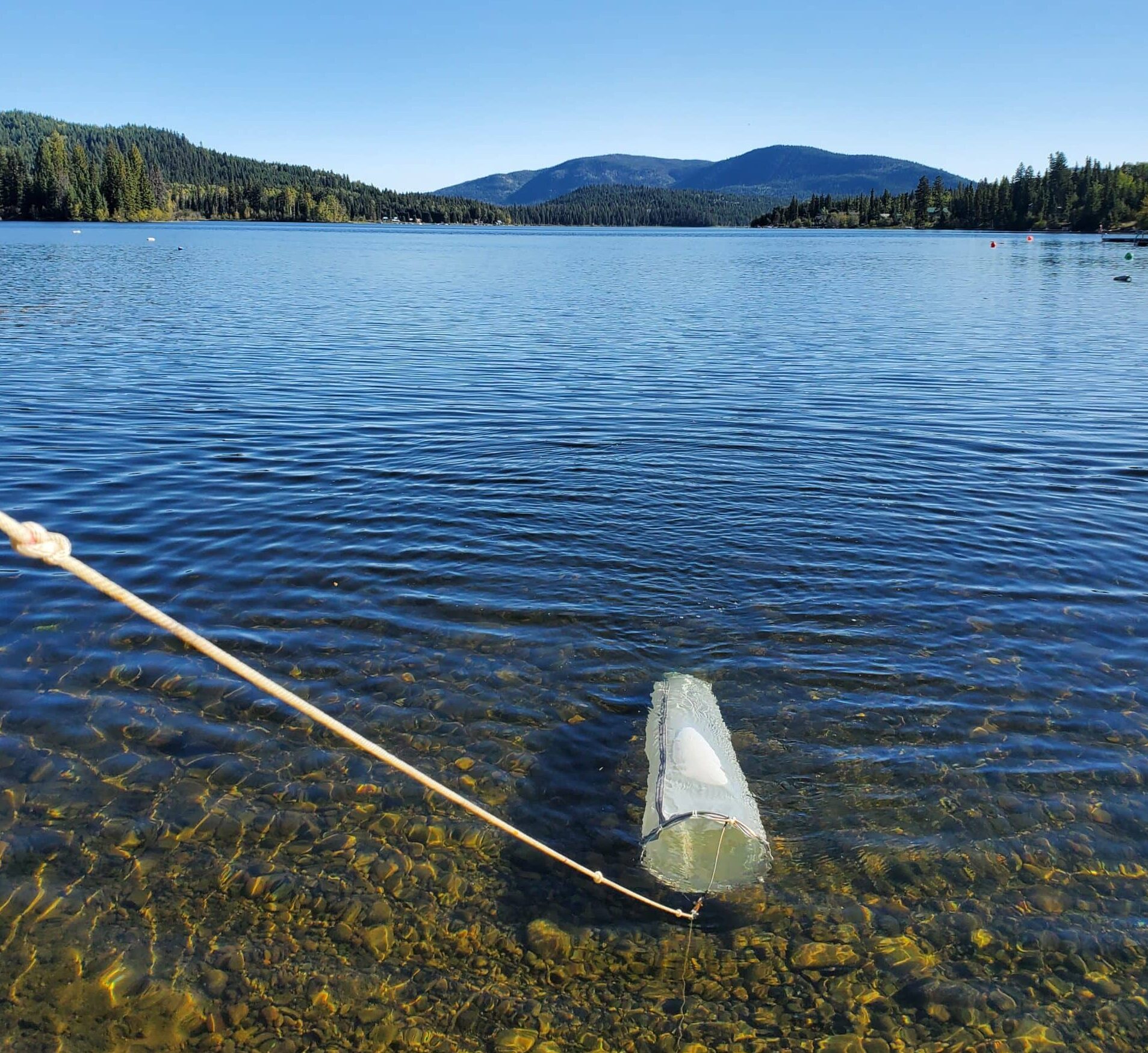
Another method of detection is plankton tows with a specialized net. Before performing the tows, the lake temperature and pH are measured. These samples help detect invasive mussels at their earliest life stage when they are still microscopic. “A highlight for me is seeing how the water samples vary in colour, temperature, and pH across the different lakes we drive to,” said Kate

Kate performing a plankton tow to detect the earliest signs of invasive mussels. Photo Credit: Alex Mutch, ISCBC.
After each survey, all equipment is carefully cleaned and decontaminated following the Provincial protocol to prevent the accidental spread of aquatic invasive species and to avoid cross-contamination that could affect test results. Back at the office, field data is recorded, and water samples are sent to a lab designated by WLRS for analysis using a specific microscopy method. This work is part of the Province’s Invasive Mussel Defence Program, and the lake monitoring component is supported by a partnership with the Habitat Conservation Trust Foundation.

Clean, Drain, Dry procedures prevent the spread of aquatic invasive species and protect waterbodies across B.C. Photo Credit: Kate van den Berg, ISCBC.
Monitoring days often involve visiting two to four lakes and spending several hours on the road, offering the chance to experience the incredible diversity of the Cariboo region. The crew has spotted wildlife such as moose, sandhill cranes, and Bonaparte’s gulls, and often chats with curious residents about the importance of preventing the introduction and spread of invasive species.
“Most folks are hugely relieved to hear that [invasive] mussels have not yet been detected in the province, and that programs like this help monitor and prevent the spread of harmful species,” says Kate.
How You Can Help Lakes Across B.C.
Like the mussel monitoring crew, every time you exit a waterbody, always Clean, Drain, Dry your boat and equipment, Pull the Plug, and stop at open watercraft inspection stations. Simple steps make a big difference when it comes to invasive species.
Thoroughly inspect your boat and gear. Remove and properly dispose of any dirt, plant fragments, or animals, especially from hard-to-reach places. Drain all standing water before leaving the area and Pull the Plug! In B.C., it is illegal to transport a watercraft without removing the drain plug. Finally, dry your gear and watercraft completely before visiting another waterbody to prevent the spread of invasive mussels and other aquatic invasive species.

Vast numbers of invasive zebra and quagga mussels covering the shoreline of Lake Winnipeg, Manitoba. Photo Credit: Gary Goodwin, ISCBC.
Any suspected invasive mussels should be reported immediately to the Conservation Officer Services Report All Poachers and Polluters (RAPP) line: 1 (887) 952-7277.
Any other invasive or unidentified species should be reported via the B.C. Provincial invasive species reporting platforms (email, online form, or Report Invasives mobile app). Ideally, each report will include images of the species, location (with geographical coordinates), and date of observation.
By staying informed, practicing Clean Drain Dry and Pull the Plug, stopping at inspection stations, and reporting suspected sightings, we can all help keep invasive mussels out of freshwater habitats across B.C.!
The Invasive Species Council of BC recognizes the Habitat Conservation Trust Foundation, the Province of British Columbia, and Fisheries and Oceans Canada for making significant financial contributions to support the Cariboo Region Invasive Mussels Lake Monitoring Program. These lake monitoring efforts support the Province’s ongoing delivery of the Invasive Mussel Defence Program.


Veronica is an Invasive Species Coordinator at ISCBC. She values working in an inclusive and diverse environment that allows her to connect with people across Canada to discuss conservation initiatives, social resilience, and restoration topics. In her spare time, Veronica enjoys spending time in the forest, identifying species she encounters or at the beach with a book in her hand. You can reach Veronica at vpanama@bcinvasives.ca.
Share


